Reading freezer-use instructions on food storage containers
A freezer container needs to suit both the time it spends frozen and the way you fill, open and thaw it.
Choose the container and organise the frozen portions
Find an explicit freezer-use statement for the exact container, including its lid. A food-contact symbol alone does not describe freezing performance. Check whether the instructions require headspace, restrict certain foods or describe thawing before opening. If the label has disappeared, search the model rather than relying on another tub from the same brand.
Leave the amount of expansion space specified by the maker. Liquids can expand as they freeze, so a container filled to its brim may not have room to accommodate them. Do not use a universal gap for every shape and food. A narrow-necked jar, a shallow box and a soup tub are different designs, and some are simply unsuitable for the job.
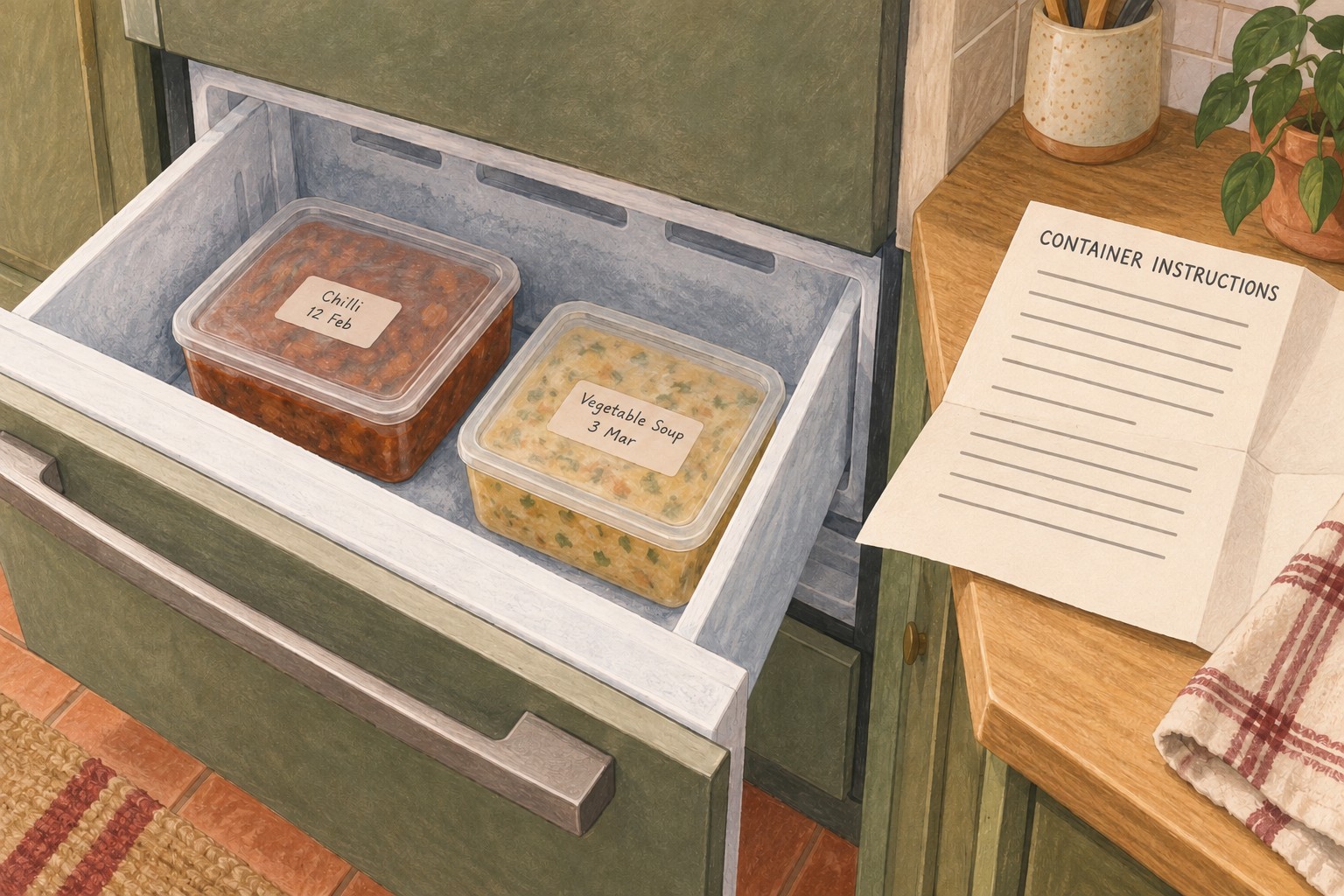
Choose portions you can use in one cooking session. Several smaller containers can be easier to arrange and thaw than a large block that encourages repeated partial thawing. Label the contents and freezing date on the outside without covering care information. Leave enough room around newly stored food for the freezer to work as its manual directs.
Keep frequently used portions accessible without balancing heavy containers above the drawer edge. A lid that is easy to operate at room temperature may be less flexible when cold. Pyrex's US instructions, for example, tell users to allow its plastic covers and dishes to defrost before trying to remove the cover because frozen plastic can crack. Follow the directions for your own product rather than forcing a frozen catch.
Freezer-to-heat is another question
Freezer suitability does not establish that the container may go directly into a hot oven or microwave. Thermal changes, lids and appliance modes have separate limits. Plan a suitable thawing method for the food and transfer it when the container instructions require this. Do not leave perishable food on a worktop for a long period merely to make the lid easier to remove.
After washing, inspect the rim and hinges before the next fill. A crack around the seal or a distorted lid can defeat the storage arrangement even if the base still looks sound. Replace a compatible damaged component where possible; do not keep using a box whose closure needs improvised tape. Dry parts before putting them away so the next batch starts with a clean, identifiable container.