Food-contact symbols and the limits of a symbol
A food-contact symbol answers one question about intended use. It does not replace the words that explain temperature, cleaning or food restrictions.
Read symbols alongside the product description
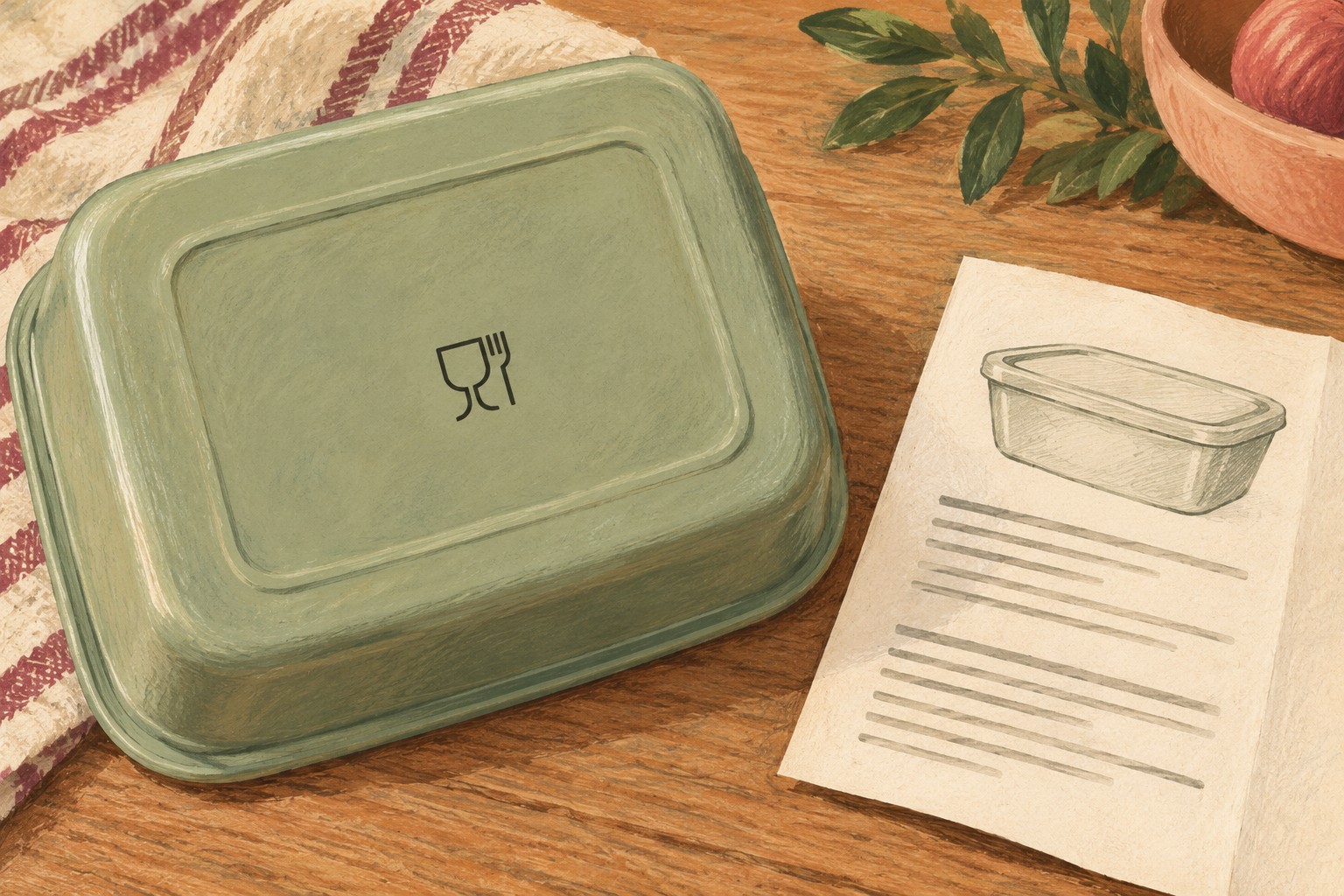
The familiar glass-and-fork symbol indicates suitability for food contact in the relevant labelling context. It is not a universal oven, microwave or dishwasher mark. A storage box can be intended to hold food while still having restrictions on heat, duration or particular foods. Look for instructions nearby and on the original packaging.
Some objects are plainly intended for food use and may not carry that exact symbol. Its absence alone therefore does not establish that a plate is unsuitable, just as its presence does not explain every permitted task. Buy from a supplier who can identify the product and its use rather than trying to decide everything from a small moulded icon.
Try reading a container label as a set of independent statements: intended for food storage; suitable for the freezer; body permitted for microwave reheating; lid to be removed; hand washing recommended. Combining those into one vague safe-container label loses the distinctions that guide actual use. A household note can be short while still preserving the important conditions, such as body only for reheating, lid off.
Keep separate permissions separate
A snowflake, microwave illustration and dishwasher pictogram may describe different capabilities. Designs are not always identical between manufacturers, so use the key supplied with the product when available. A number beneath a recycling triangle identifies a material category; it is not a temperature setting or a food-safety score.
Check whether the symbols apply to the whole item or only one part. A container base and its lid may need different treatment. A product page may show a family of items while the specific size you buy has another closure. Save the instructions for the exact version and make sure they agree with the markings on the received product.
Words such as reheat only, remove lid or top rack can materially change the meaning of a large icon. Do not discard those qualifications when making a household label. If several people use the containers, a short note saying which lids must come off may prevent more mistakes than copying the symbol alone.
A symbol may also need a temperature or position qualification. Dishwasher information can specify a rack or exclude a decorative component. An oven symbol may apply to a vessel but not its removable cover. Keep the written conditions with the symbol when sharing instructions with another household member. Do not replace the manufacturer's care information with a simplified chart that silently extends permission to other parts.
Ask a precise question when the mark is unclear
Send the seller a photograph of the symbol and the model code, then describe the intended task: for example, reheating a refrigerated meal in ordinary microwave mode. Asking whether the box is safe invites a broad answer; asking whether that use is permitted is easier to resolve.
If the supplier cannot provide the information, choose a different vessel with explicit instructions. Do not test suitability by putting an unknown container into high heat. The European Commission's food-contact framework concerns intended use and safe-use information, not a single symbol that can validate every kitchen experiment.
For products bought second-hand, ask for a photograph of the base and any surviving packaging before purchase. A faint or damaged mark can be difficult to interpret from memory. If the maker can identify the model, obtain the original care information. If it cannot, choose a limited use supported by reliable information or a different product; do not infer a heat rating from the object's weight, thickness or the fact that it looks like another familiar container.