What an ingredient percentage does and does not tell you
A percentage is meaningful only when you know what it measures, what the finished product is and how it is intended to be used.
Find the denominator
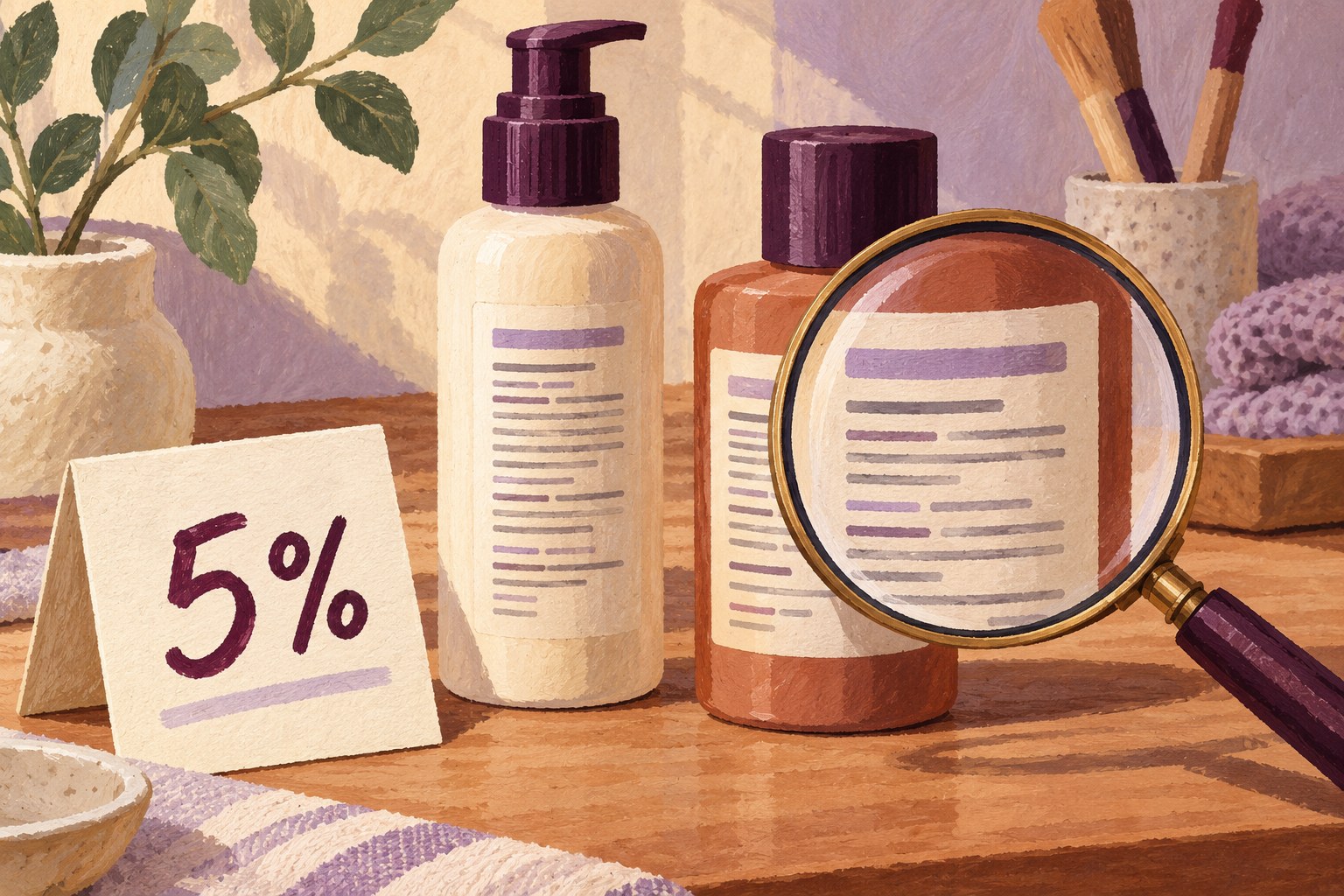
A claim such as “contains 5%” should identify 5% of what. It might describe an ingredient in the finished formula, a solution containing that ingredient or a group of materials. If the wording does not make this clear, ask the manufacturer before comparing it with another product.
A front-label percentage is not necessarily a full formulation disclosure. It may highlight one component while leaving the rest unspecified. The presence of a number can make a claim look precise even when its scope remains ambiguous.
Compare the same kind of product
A rinse-off product and a leave-on product can have different contact times and directions. A concentrate and a ready-to-use cleaner are handled differently. Comparing percentages without those distinctions can produce a misleading ranking.
For a cosmetic, formulation and application conditions affect how a product behaves. For a cleaner, compatibility, dilution and the target task matter. A larger number is not automatically more effective, more irritating or a better purchase in every context. Nor does a smaller number establish that a product will be suitable for a particular person.
Do not infer percentages from list position
Cosmetic ingredient declarations generally give an order rather than a complete set of concentrations, with exceptions that depend on the applicable rules. In US labelling, ingredients at one per cent or less can be ordered differently after those above that level. The list therefore cannot be converted into an exact recipe by counting positions.
You also cannot reliably identify the one-per-cent boundary from a popular ingredient’s assumed usual concentration. A general formulation habit is not evidence about the exact bottle in front of you. Ask for the specific information if it is material to your decision.
Separate a test result from an ingredient amount
A test report might give a measured concentration of a substance, a detection limit or a percentage reduction under specified conditions. Those are different numbers. “Not detected” means below the test’s detection capability under its method, not necessarily absolute absence in every unit produced.
Similarly, a reduction claim needs a baseline. Reduced compared with which previous formula, reference product or untreated sample? Without that comparison, the number may not answer the question you thought it did.
Check units before copying a figure
A percentage, parts per million and a mass per item describe quantities differently. A result from one unit cannot be placed next to another without understanding what was measured. Even a correct mathematical conversion may be unhelpful if the samples, methods or product parts differ.
If the report is technical and the number is central to your decision, ask the supplier or a qualified person to explain the relevant result. Avoid presenting a copied figure in a review as proof of a health outcome that the test did not investigate.
Use numbers to clarify a practical choice
Suppose two concentrate bottles list different dilution instructions. Compare the quantity of correctly prepared solution each produces for the same permitted task, not just the percentage on the front. Include the measuring and storage requirements. A more concentrated option may save space but be less convenient for someone who finds accurate dispensing difficult.
For a personal-care product, ask whether the percentage changes the instructions or precautions and whether you have a specific reason to seek that formulation. Do not move towards progressively higher concentrations because a routine seems slow to deliver a cosmetic effect. Persistent skin concerns deserve appropriate advice.
Keep the full wording with the number when taking notes. “5% of the stated blend in a rinse-off product” preserves more information than “5% active”. A careful note makes later comparisons less likely to turn different measurements into a false league table.