Chemical-free: why the wording does not explain a product
Chemical-free does not identify what a product contains or what it is designed to do. Replace the broad phrase with a question that can be checked.
Why the phrase is uninformative
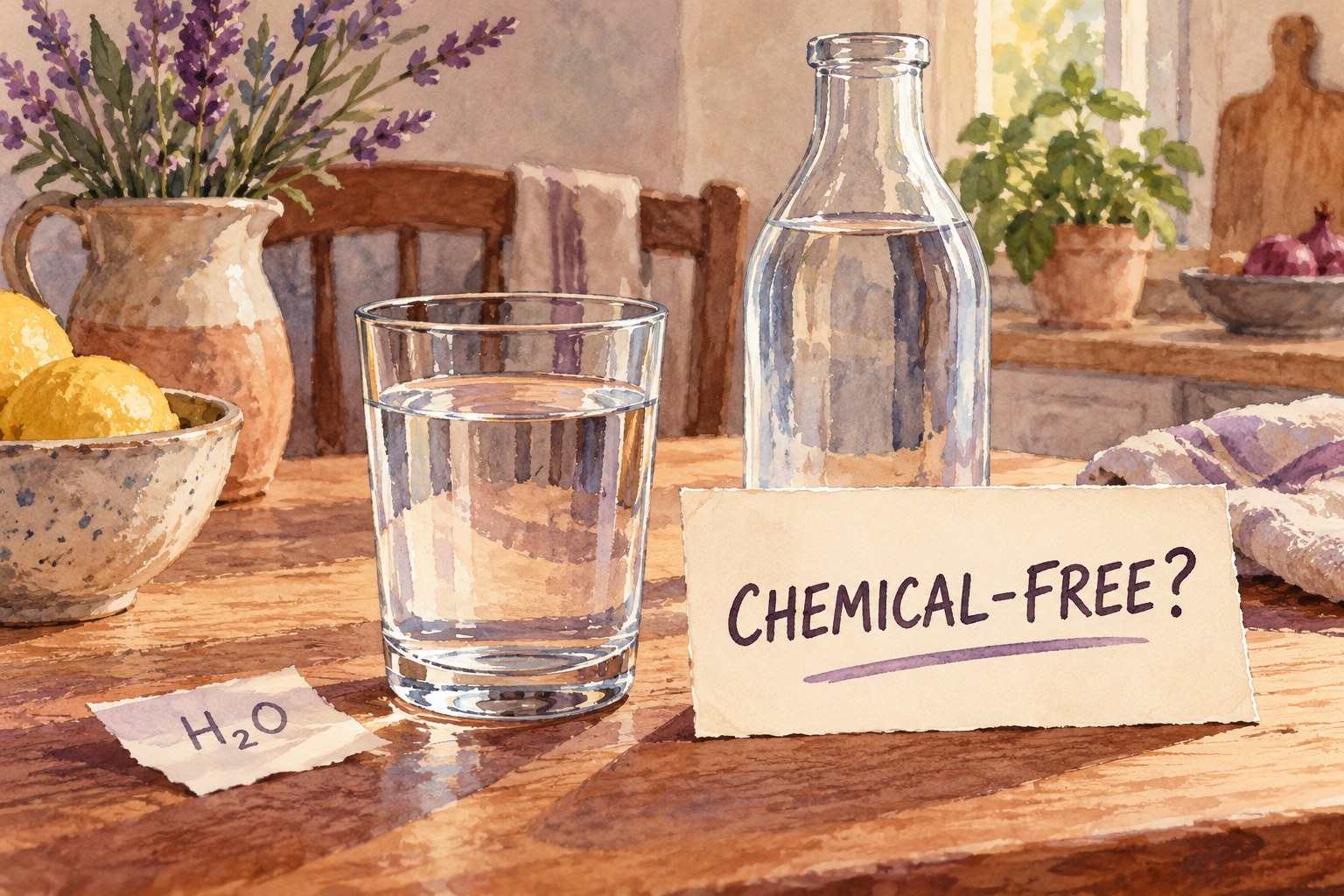
Water, oils, minerals and the materials in a bottle are chemicals. A finished household or personal-care product therefore cannot be assessed by pretending that some products contain chemicals and others do not. The useful distinctions concern which substances are present, their properties and the conditions of use.
Sometimes a seller intends chemical-free as shorthand for the absence of one particular ingredient. If so, that ingredient should be named. Without a clear scope, shoppers may read very different promises into the same phrase: no fragrance, no solvents, no preservatives or no synthetic ingredients. Those are not equivalent claims.
Replace the phrase with a concrete requirement
If you want a cleaner without added fragrance, ask for that information. If you need a product compatible with a stone worktop, ask about the exact stone and finish. If a clinician has identified an allergy, check for the relevant ingredient names. Each question produces a more useful answer than asking for something with no chemicals.
A requirement should also identify the product part involved. “No added fragrance in the detergent” says something different from “packaging contains no recycled plastic”. Neither statement should be expanded into a claim about every aspect of the product.
Do not confuse a missing ingredient with a complete assessment
A free-from statement can be accurate and still leave other questions unresolved. Knowing that one substance is absent does not tell you what replaced it, whether the formula suits the intended task or how it should be stored. It also does not establish that the excluded ingredient would have presented a problem in every formulation.
For example, comparing two cleaners by counting their free-from statements ignores whether either is suitable for the surface. The bottle with fewer claims may have clearer directions for the actual floor. The bottle with more claims may still require gloves or ventilation. Read the functional information before turning absence into a score.
Keep warnings in context
Chemical hazard labelling describes particular hazardous properties under a defined classification system. It is not a competition between chemical and chemical-free products. A warning on a concentrate can be relevant to handling before dilution, while the directions explain its intended preparation and use.
Do not remove a warning because a product is plant-based, and do not assume that an unfamiliar ingredient name means the product cannot be used as directed. Where information is unclear, ask the supplier. If the required precautions cannot be followed in your home, choose a suitable alternative for that reason.
Read the replacement claim too
When a product advertises the removal of an ingredient, ask what specific benefit the company is claiming and how it supports that comparison. A reformulation may change texture, scent or packaging at the same time. Those changes should not all be attributed to the absence of one substance without evidence.
You can still choose the new product if it meets your needs. The point is to describe the reason accurately rather than assuming that removal always means a measurable health improvement.
A better way to record a purchase
Write down what you verified: the full product label was available, the surface was listed as compatible, the fragrance requirement was met or a relevant certification entry matched. Keep unanswered questions separate. This avoids turning a reassuring phrase into evidence it never supplied.
When describing a product to someone else, use the same precision. “This one is labelled fragrance-free and the directions cover my sealed floor” gives them information they can check. “It has no chemicals” gives them no meaningful basis for deciding whether it fits their situation.
If a seller cannot explain a central claim beyond repeating it, you can choose another product with clearer information. That is a decision about transparency and suitability, not a diagnosis that the original product is dangerous.