Renovation dust: when to ask a qualified professional
Before sanding, drilling or removing an old surface, establish what may be disturbed. Ordinary household cleaning equipment is not a substitute for a renovation risk assessment.
Stop before making dust
An old wall, floor covering or painted surface may contain materials that cannot be identified reliably from appearance. Do not scrape a small sample, drill a trial hole or sand an edge simply to see what is underneath. Those actions can create the exposure you are trying to understand.
Gather existing information instead: building age, previous surveys, product records and the planned scope of work. Tell the contractor exactly which surfaces will be disturbed. HSE notes that refurbishment and drilling can disturb asbestos-containing materials, particularly in older buildings. A general statement that the house was renovated once is not a substitute for information about the specific area.
Ask what the assessment will cover
A suitable professional should explain whether inspection, testing or a specialist survey is needed before work begins. Ask who will perform it and what their qualifications cover. A quotation for decorating may not include assessment for asbestos, lead or other hazardous materials. Make the boundary explicit rather than assuming someone else has checked.
For suspect materials, use the appropriate local regulatory guidance and qualified services. Do not follow an online removal tutorial or assume that a disposable mask makes the work manageable. Some tasks require licensed contractors or particular controls; the requirements depend on the material, activity and jurisdiction.
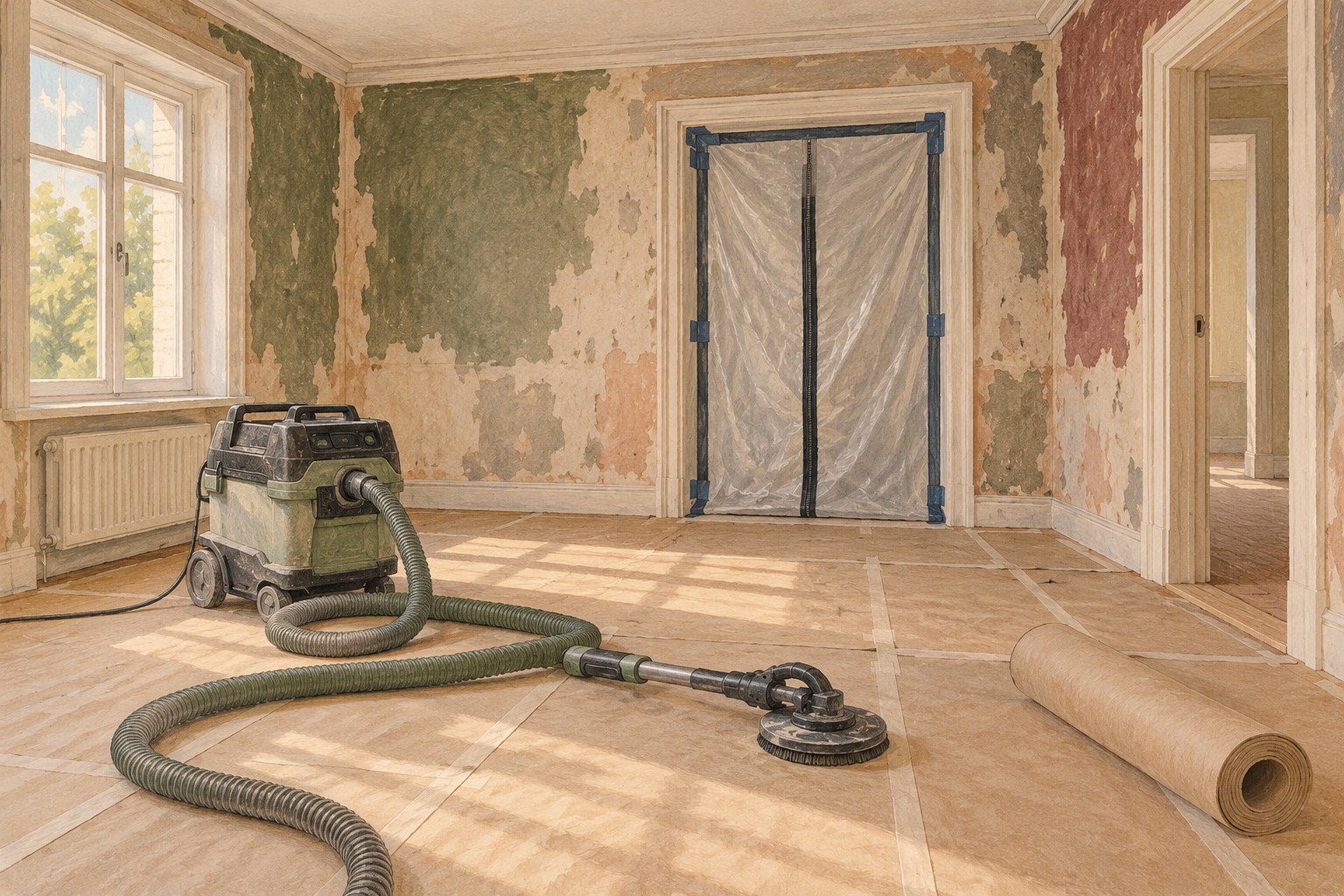
Discuss how the work area will be separated from occupied rooms, how dust will be controlled and how waste will be handled. Ask what will happen if an unexpected material is uncovered. A clear stop-work plan is more useful than an assurance that the job will probably be fine.
Ask how the contractor will distinguish their own work from any specialist work required first. A useful written scope identifies who arranges assessment, who receives the results and who decides that ordinary preparation may begin. If no one has accepted that responsibility, do not let the timetable turn the uncertainty into an assumption. Clarifying it before tools are used is easier than dealing with contamination afterwards.
Plan the household around the work
Agree where people and pets can be during the job and whether temporary relocation is needed. Protecting possessions is different from protecting occupants, so plastic sheets over a sofa are not the whole plan. Keep access routes and ventilation arrangements consistent with the contractor's controls.
Do not use an ordinary domestic vacuum on suspected hazardous renovation dust. It may be unsuitable for the material and can spread contamination. If dust has already escaped, stop the activity, keep people away and seek professional advice on cleanup rather than dry sweeping it through the home.
Keep the completion records
Ask for the relevant survey, test, work and disposal documents and an explanation of any remaining restrictions. Store them with the home's maintenance records. A freshly painted surface does not itself prove that a hazardous material was removed or safely managed.
Future work may disturb another area, so do not generalise one assessment to the whole building. Keep the scope and dates clear. For routine non-hazardous decorating, sensible dust control still matters, but identifying the material comes first. Buying a stronger cleaner or a larger air purifier after the event cannot replace that decision.