Reading a test report without turning it into a blanket guarantee
A test report is evidence about a sample, method and set of conditions. Reading those details helps prevent a narrow result becoming a claim about everything a product might do.
Match the sample to the product
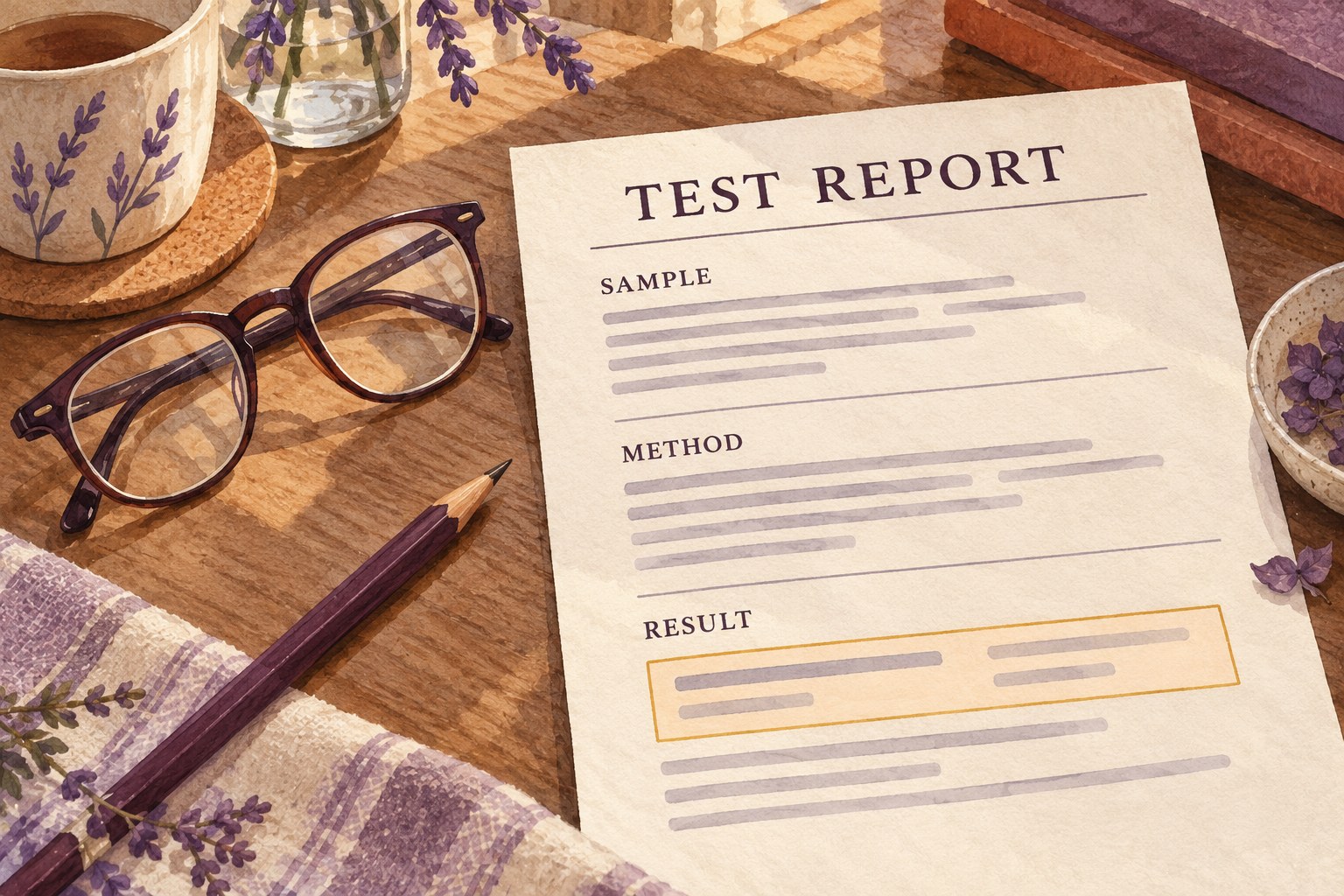
Find the sample description, model, batch or other identifier and test date. Check whether the report concerns a raw material, a component or the finished item. A textile swatch test does not necessarily describe the entire upholstered chair, and a coating sample may not establish the condition of a used pan.
Ask who selected the sample and whether the current product is unchanged. A report supplied by a manufacturer can be useful, but the relationship between sample and sale item still needs to be clear. A cropped image showing only a pass statement removes information you need to assess that relationship.
Read what was actually measured
Identify the method, substances or performance properties and the conditions used. A heat test at one temperature and duration does not establish unlimited heat tolerance. A chemical-content result is different from a migration result under simulated use. Do not substitute one question for the other because both include a chemical name.
Look at units and reporting limits. Less than a stated value is not the same as zero, and not detected is tied to the method's capability. A pass should identify the criterion against which the result was judged. Ask which jurisdiction, standard version or specification supplies that criterion.
If several samples were tested, check whether the reported conclusion applies to all of them. One successful sample is not necessarily evidence about every colour, material combination or production batch. Likewise, a report's date is relevant when a product has changed since testing.
For example, a report that measures substance content in a material does not automatically tell you how much would transfer during a particular cooking or washing routine. Conversely, a migration test has specified contact conditions that should be read before applying it to another use. You do not need to calculate personal exposure from the report to recognise that these are different measurements.
Understand laboratory accreditation
Accreditation concerns a laboratory's competence within a defined scope. UKAS explains that recognition relates to the activities included in that scope. A laboratory's logo does not mean every possible test it performs is accredited, and laboratory accreditation is not a blanket approval of all products a client sells.
Where accreditation matters to the claim, verify the organisation and scope through the accreditor's directory. Match the report's test to that scope. Do not assume ISO/IEC 17025 printed somewhere in a document means the specific product is certified to a consumer safety standard.
Translate the result into a limited conclusion
A useful conclusion might be that the identified sample met the stated criterion under the reported test conditions. That is more precise than safe for everyone or free of all harmful substances. It leaves room for other relevant issues, including mechanical damage, misuse, individual allergy and properties that were not tested.
If the claim on the product is broader than the report, ask the supplier for the missing evidence. For example, a single-substance result cannot support a sweeping chemical-free claim. If the report is incomplete or too technical for a purchasing decision, a qualified explanation may be necessary.
A comparison can fail even when both reports are genuine. One may concern a new unused sample and another an aged sample, or they may use different temperatures and durations. Write down these differences before treating the results as a league table. If the differences cannot be reconciled, describe the comparison as unresolved rather than selecting the product with the smaller-looking number.
Store the context with the result
Keep the complete report, the product listing and the supplier's explanation together. Do not save only a green pass icon. Note the version you bought so the evidence can be reconsidered if a replacement product has a different construction.
A report can reduce a specific uncertainty, but it does not replace use instructions or make a damaged product suitable. Read it as one part of the information available, alongside the product's intended purpose, care requirements and relevant local rules.