Organic claims on cosmetics: checking the certification scope
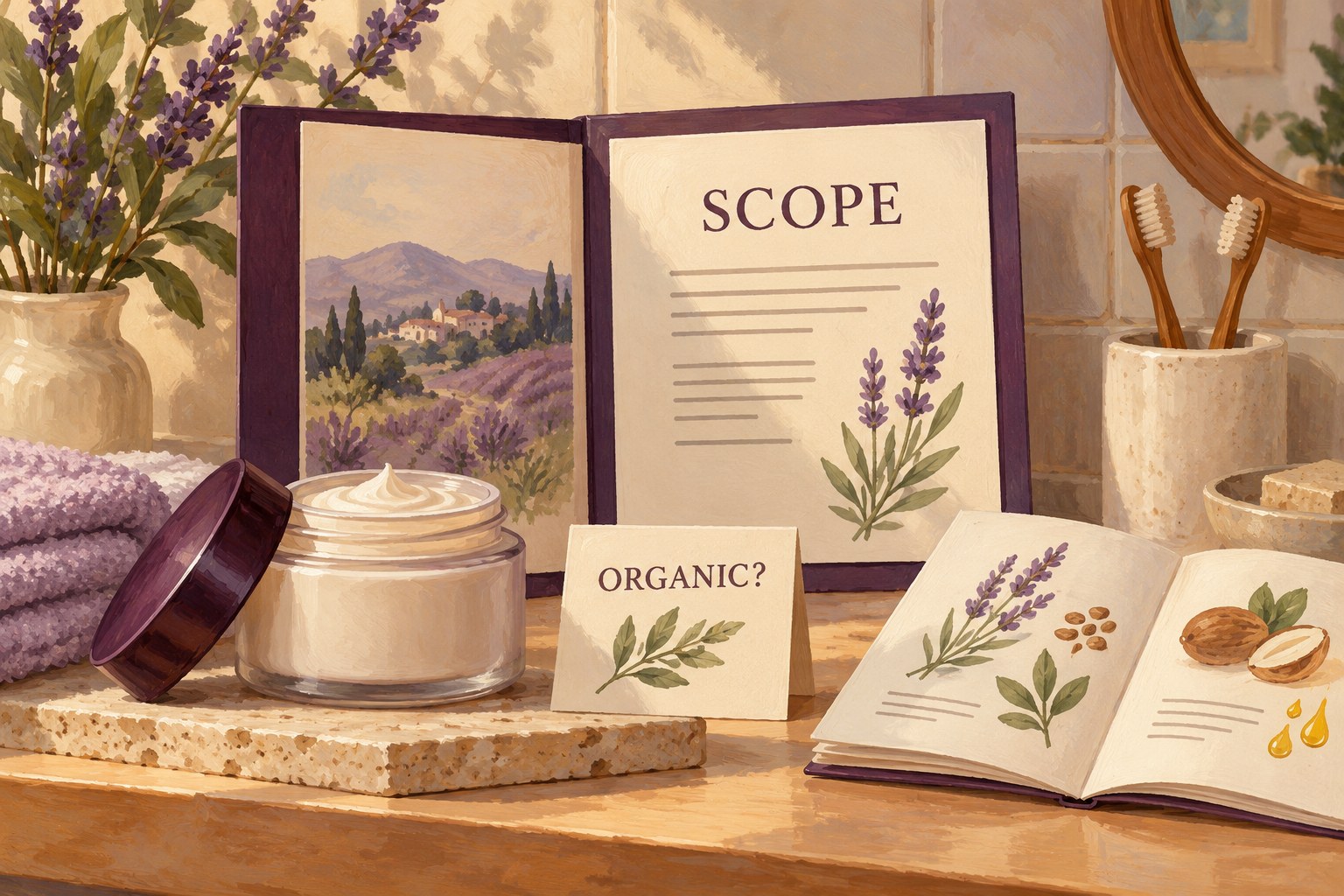
Organic can refer to ingredients, a certified finished cosmetic or a particular production scheme. Read the certification name and percentage basis before comparing products.
Identify the scheme and the item
Find the named certifier or standard rather than relying on a leaf illustration. Check whether the claim concerns the complete cosmetic, one ingredient or the packaging. A product containing an organic plant oil is not necessarily certified as an organic finished formula. The distinction should be visible in the wording.
Look for the exact product in the scheme's directory where one is available. Match the name, manufacturer and version. A certificate for a raw material supplied to many companies does not automatically certify every final product containing it. If the brand provides only a certificate image, ask what product and dates it covers.
Percentages need a denominator
A percentage of organic ingredients can be calculated on different stated bases. COSMOS explains that labels may show the organic proportion of the whole product and, where relevant, a figure excluding water and minerals. Those are different denominators. Do not compare them as though they describe the same fraction.
For example, a water-rich lotion and an oil blend can have very different whole-formula percentages without that alone establishing which is more suitable for your skin. The percentage is a sourcing and formulation statement. It does not measure moisturising performance, fragrance tolerance or the probability of an individual reaction.
US and private-scheme meanings differ
In the United States, USDA organic requirements can apply to qualifying agricultural ingredients and products under the National Organic Program, while cosmetics remain subject to cosmetic safety and labelling requirements. FDA does not treat organic as a separate guarantee of cosmetic safety. Do not apply a US certification definition automatically to every international label.
COSMOS ORGANIC and COSMOS NATURAL are also distinct signatures. The latter is not simply another spelling of organic certification. Read the scheme's current explanation instead of assuming that every certified natural product meets the same organic-content requirements. These schemes can be useful, but only when the claim is described accurately.
Work through a percentage example
Imagine one label states 20 percent organic of the total formula, while another states 95 percent organic excluding water and minerals. Those figures cannot be ranked directly. Ask for the whole-formula figure for the second product or the comparable basis for the first. The example does not imply that either product is poorly formulated; it shows why the denominator must travel with the percentage.
Also distinguish an ingredient highlighted on the front from the formula as a whole. Organic aloe in a cream describes that ingredient unless the accompanying certification and wording establish more. If sourcing that ingredient is your priority, the statement may be useful. It should not be expanded into a claim about the origin of every other ingredient, the product packaging or the likelihood of irritation.
Keep everyday suitability in the comparison
Read the ingredient list, directions, warnings and expiry information as you would for any cosmetic. Plant-derived ingredients can still cause reactions in some people. A certified organic fragrance does not become fragrance-free, and a sourcing standard does not replace a clinician's advice about a known allergy.
Compare the format and amount you will use. A product that fits your routine and comes with clear instructions may be a better purchase than a larger bottle chosen only for its certification. If you have not used the formula before, avoid committing to a large refill solely because the label is familiar.
When asking a brand for clarification, name the precise uncertainty: whether the finished formula is certified, which percentage is shown or whether the current version appears in the directory. That question is easier to answer than asking whether the product is truly clean. Keep the answer with the product information so future reformulations can be checked separately.