EU Ecolabel: checking the product group and licence
The EU Ecolabel is awarded within defined product groups and criteria. Check the exact product and licence rather than treating a company’s environmental image as certification.
Establish what carries the label
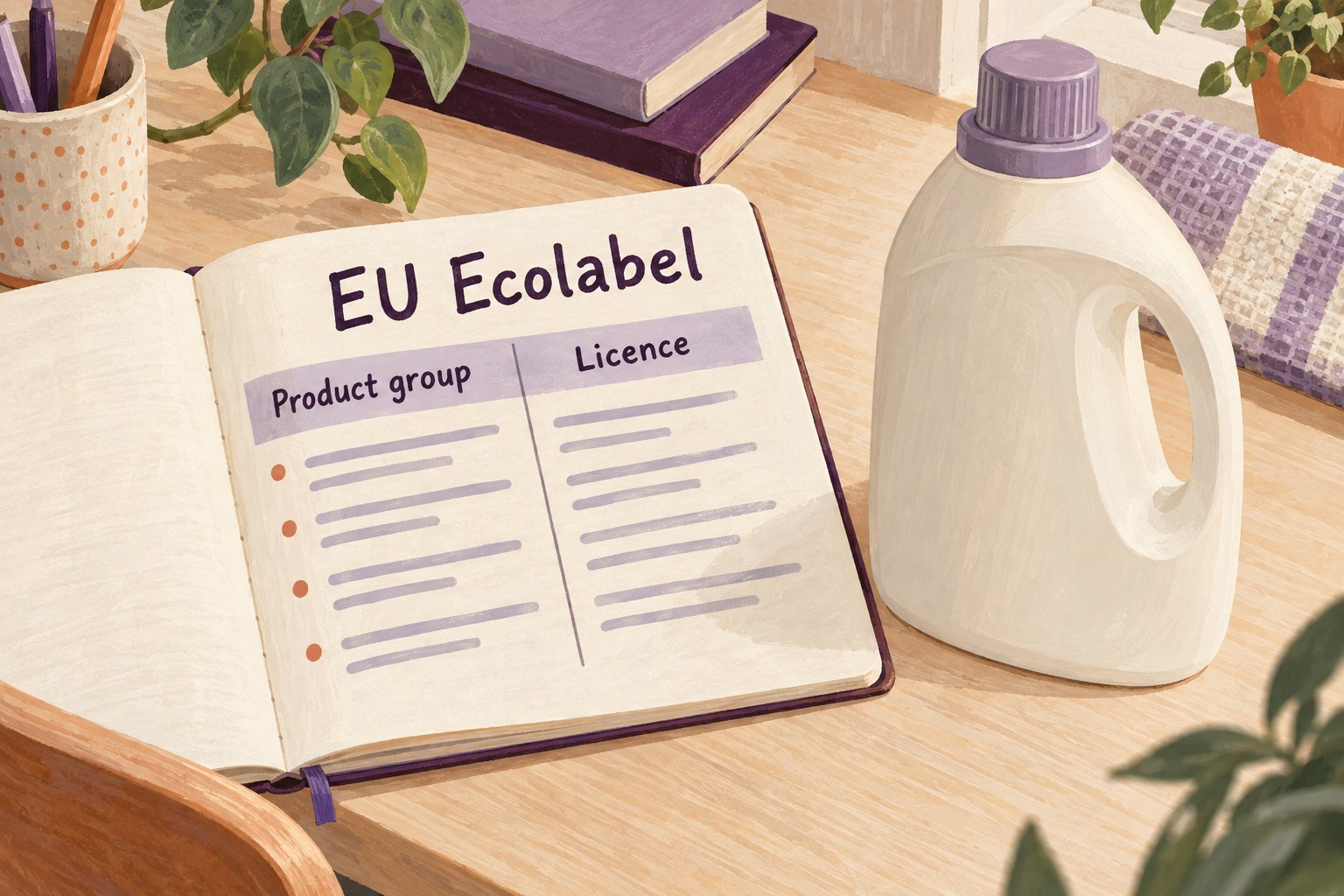
Look at the complete product name, variant and licence information. A company may use the EU Ecolabel for selected goods while selling other goods without it. A logo in a website footer does not necessarily identify the particular bottle, textile or service you are considering.
The programme covers different product groups with different criteria. A detergent, paint and textile do not pass one identical test. Understanding the product group helps you ask what aspects have been assessed and what still needs a separate check.
Use the official catalogue
The European Commission’s EU Ecolabel product catalogue provides category browsing and search tools. Search using the exact name or supplier details, then compare the result with the current pack. Keep the licence information where available so that similarly named products are easier to distinguish.
The catalogue explains that licence holders are responsible for registering their products and that the list can be non-exhaustive. Therefore, an unsuccessful search alone does not prove that a label claim is false. It is a reason to seek clarification from the supplier or the relevant programme contact.
Conversely, finding a company does not verify every item on its retail page. Match the product-level information rather than stopping as soon as the brand appears.
Read the criteria as a defined scope
The scheme uses criteria that consider relevant environmental aspects for the product group. A label can therefore provide more structured information than an undefined green claim. It is still important to avoid turning that into a promise about every characteristic a shopper may value.
For example, certification does not automatically answer whether a product contains a particular ingredient to which you are allergic, whether it suits an unusual surface or whether its dispenser works for your grip. Those require the full label, material instructions or a specific question to the supplier.
Keep environmental and use questions together
A concentrated cleaning product may have a credible environmental claim and still require accurate dilution. A refill can reduce a particular packaging requirement while introducing cleaning and storage steps. Evaluate whether the product’s intended routine is practical in your home.
Do not use more of a certified product because the label feels reassuring. Follow the dose and disposal instructions. Environmental certification does not make it appropriate to mix cleaners, release them outdoors or ignore local waste arrangements.
If comparing products from different groups, avoid declaring one more certified than another. Compare products serving the same job and explain which criteria are relevant to that job.
Check the licence behind a retailer badge
A retailer may add its own green shopping badge alongside an official label. Distinguish the two. The retailer’s category may use different criteria and may include products that do not carry the EU Ecolabel. Read which claim is actually made for the item.
When saving evidence, keep the official licence or product information rather than only the retailer’s category page. This makes the record more useful if the shop changes its filters or redesigns its environmental section.
Record the evidence you actually found
A useful note contains the product, variant, licence or listing information and date checked. If the listing was incomplete but the supplier provided confirmation, save the correspondence with its scope. Do not replace uncertainty with a general statement that the whole brand is approved.
When a retailer displays only a cropped front image, request the current full label and licence details before relying on the claim. If the product changes, check again. Certification is useful when it remains attached to an identifiable product rather than becoming a permanent assumption about a colour scheme or company name.
The final purchase can balance the verified label with performance requirements, cost and availability. A product that meets a scheme but cannot be used on your surface is not the right choice for that task; a clear match requires both kinds of information.