Concentrated cleaners: measuring the dilution
A concentrated cleaner is a measuring task. The bottle size tells you little about the amount that belongs in a bucket or refill container.
Find the relevant dilution
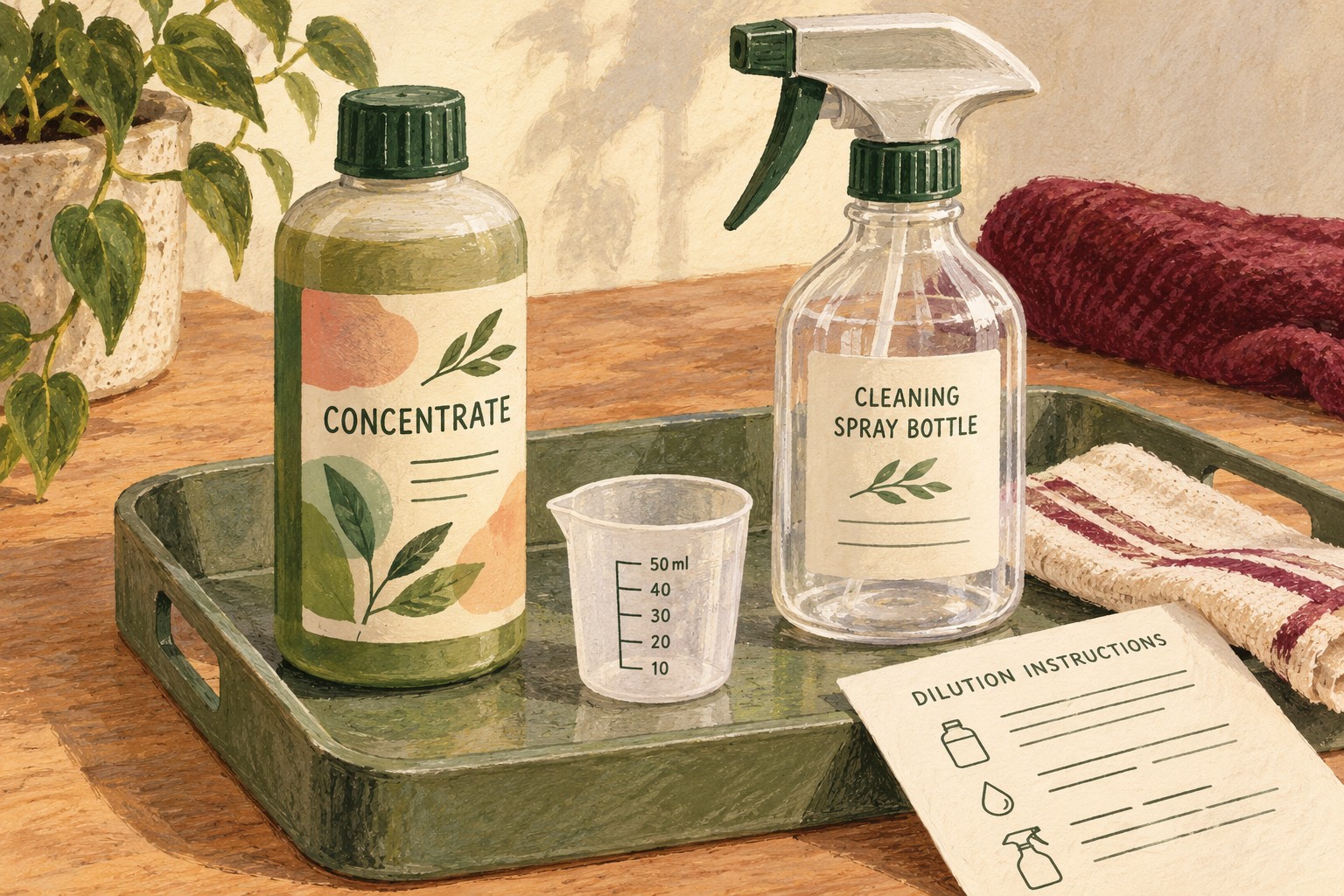
A label may give different dilutions for different jobs. Identify the one that matches your surface and purpose before measuring. Do not assume the strongest listed dilution is the default, and do not use a disinfecting dilution for an unrelated cleaning task without checking the directions.
Read whether the ratio describes product plus water or product in a final volume. These are not always expressed in the same way. If the wording is ambiguous, ask the manufacturer rather than making a chemical mixture from a guessed interpretation. Use the measuring device or dosing system specified where provided.
Keep quantities and units consistent
Millilitres, litres, caps and pump strokes are not interchangeable. A cap from another bottle may hold a different amount. Household spoons vary too, so they are a poor substitute when the directions require a measured volume.
As a purely arithmetic example, if a label specifies 10 millilitres of its product for each litre of water, two litres of water require 20 millilitres of that same product. This example is not a dilution recommendation for any cleaner. It illustrates why scaling the water without scaling the product changes the mixture.
Measure on a stable surface with appropriate protection. Do not use food utensils that may later return to cooking. Keep the concentrate closed while arranging other equipment and avoid handling a large container in an awkward position.
Label and use the prepared solution
Follow the product’s guidance about how long a diluted solution may be kept. Do not assume that a concentrate’s shelf life also applies after dilution. Identify the contents, preparation date and any required warnings on a permitted secondary container.
Never put cleaning solution in a drink bottle. An attractive reusable container without a chemical-resistant closure or adequate label is not a suitable substitute for the intended system. Do not mix a fresh batch with an unknown old remainder.
For a disinfectant, dilution is only one condition. Surface preparation, contact time, application and rinsing may also be specified. A correctly measured solution used for too short a time does not automatically meet the claim.
Make the measurement readable
A transparent measuring mark can be hard to see against a pale liquid, especially in a dim utility cupboard. Arrange adequate light and use the correct measuring tool on a stable surface. If eyesight or hand control makes the dose unreliable, a manufacturer-supported dosing device or ready-to-use format may be preferable.
Do not solve a measurement problem by marking an approximate line on an unrelated bottle without verifying the system with the supplier. Container shape and final-volume instructions can make a guessed line misleading. A dosing method should be repeatable by the people who actually use it.
Keep a written arithmetic example only for the exact product and permitted dilution it describes. Label it with the product identity and review it when buying a new concentration. An old note saying “two caps per bucket” can outlive both the cap and the bucket that originally gave it meaning.
Decide whether concentrate suits the household
Compare cost per correctly prepared quantity rather than cost per bottle. Include the measuring equipment, storage space and the likelihood that everyone will follow the same instructions. A ready-to-use product may be a better fit when measuring is difficult or the task is infrequent.
If a refill subscription delivers more concentrate than you can use, change the schedule rather than making larger batches to consume it. Concentration is a logistical property, not a reason to use more product. Keep the original label available throughout the life of the supply.