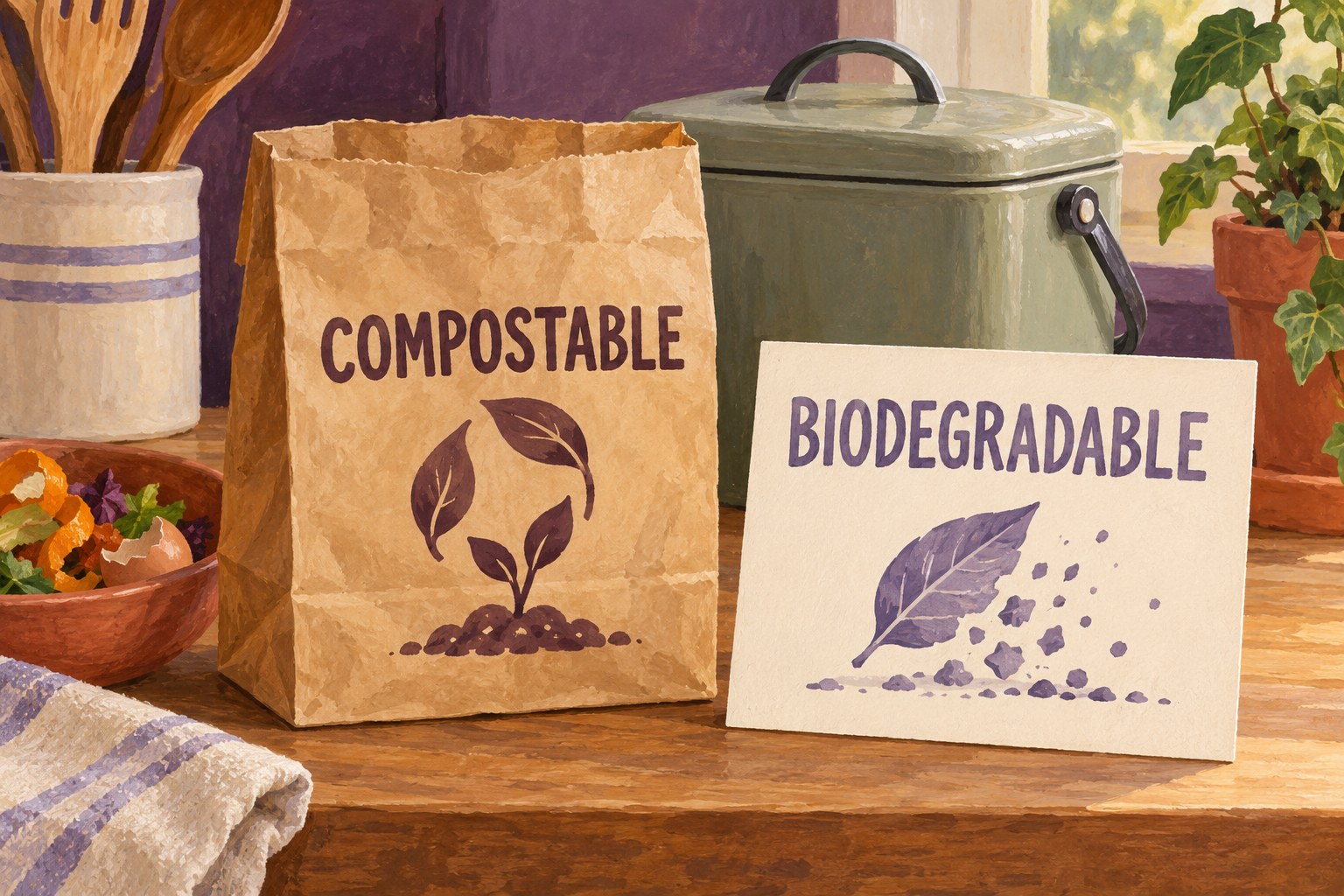
Compostable and biodegradable are not interchangeable
A material can break down under one set of conditions without belonging in your home compost bin. Read the destination and conditions behind the claim.
Ask where and under what conditions
Biodegradable is incomplete without information about conditions and timescale. It does not tell you that a product will disappear quickly in a garden, sea or landfill. Compostable is a more specific kind of claim, but it still needs to identify the composting system and the relevant standard or evidence.
Home composting and industrial composting are different environments. A package intended for a managed industrial process may not break down appropriately in a small garden heap. Do not assume that a green colour, plant-derived feedstock or a seedling-style illustration supplies the missing instructions.
Check whether the whole item is covered
Read whether the claim includes printing, labels, adhesives and closures. A compostable liner inside a non-compostable box is not a claim about the complete package. If the product has several parts, identify what should be separated before disposal.
A certification mark can help define the tested conditions, but it does not guarantee that your local facility accepts the item. Collection services may exclude compostable packaging even when they collect food waste. Ask about the exact item type rather than assuming that food-waste collection and industrial composting are interchangeable terms.
Keep it out of the wrong stream
Do not put compostable plastics into ordinary plastic recycling unless the service explicitly requests them. They can be incompatible with the intended recycling process. Recycle Now distinguishes compostable and biodegradable bags from the films accepted at many plastic-bag collection points.
Do not litter a product because it is labelled biodegradable. The claim does not authorise disposal outdoors or establish what happens in a waterway. If no suitable composting route is available, follow the local waste service's instructions instead of placing it in a bin chosen by appearance.
Compare the product's actual use
Ask whether the item performs the job and whether you can handle it at the end of use. A compostable bag that your food-waste service does not accept may be the wrong purchase for that service. A reusable alternative has its own washing and durability considerations; neither format wins every comparison automatically.
The US FTC Green Guides distinguish compostable and degradable claims and their qualifications. Those principles illustrate why context matters, but local collection rules still determine your household route. Keep the package or a photograph until you have resolved the destination, especially when the main label is removed during use.
A useful purchasing note might say industrially compostable packaging, not accepted by my council, rather than simply eco packaging. That wording preserves the part that matters to your next decision and avoids turning a specific material property into an unlimited environmental promise.