Checking cosmetic expiry and period-after-opening symbols
An expiry date and a period-after-opening symbol describe different parts of a cosmetic’s usable life. Both depend on appropriate storage and handling.
Identify the mark you are reading
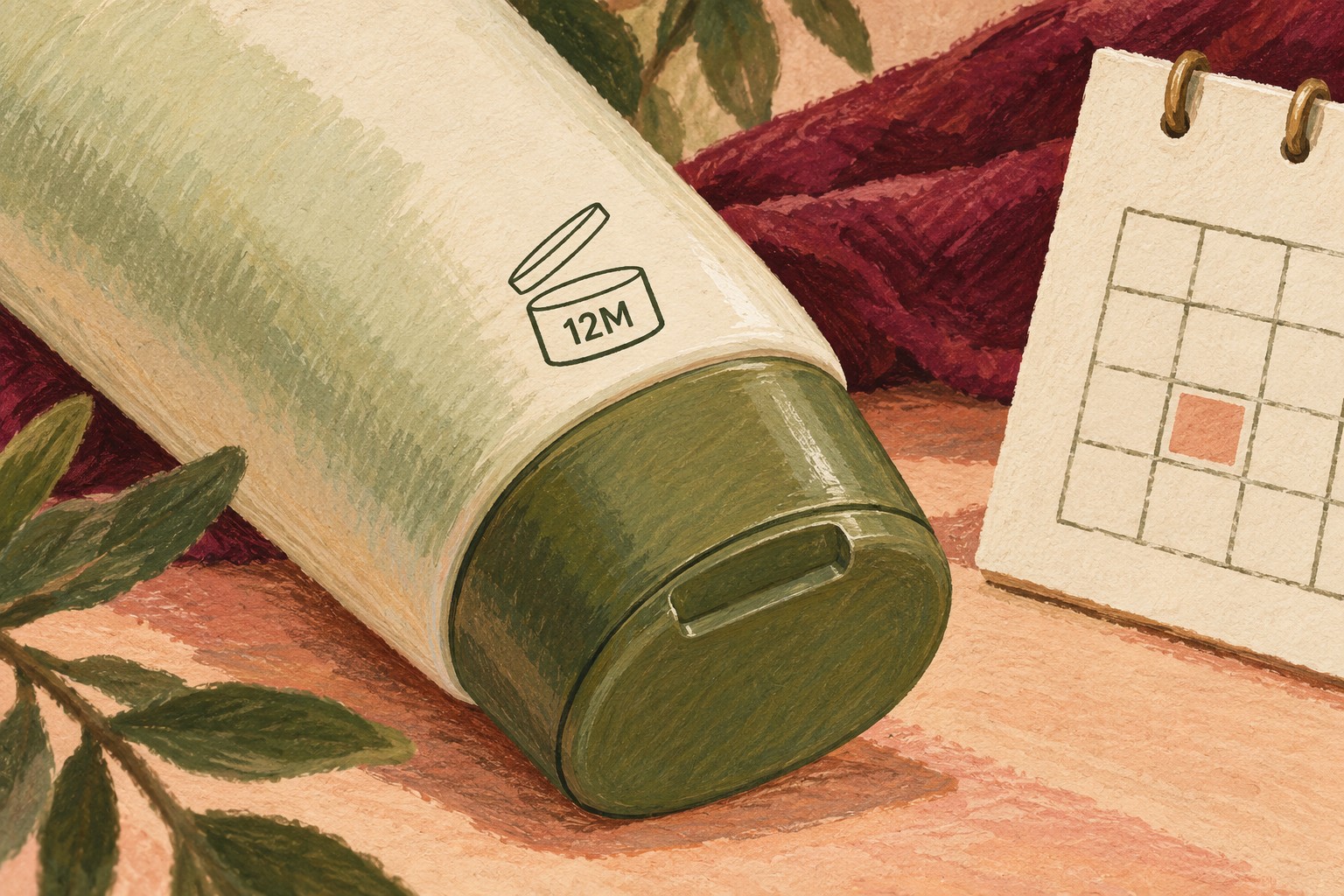
A printed date may refer to durability, while an open-jar symbol followed by a number and M indicates a period in months after opening where that symbol is used. A batch code is usually an identifier for traceability, not a date that consumers can reliably decode without the manufacturer’s help.
Labelling requirements differ between jurisdictions and product types. Ordinary cosmetics in the United States do not all have mandatory printed expiry dates; products regulated as drugs can have additional requirements. Do not use the absence of a date on a cosmetic to infer that it lasts indefinitely or that the seller has necessarily broken a rule.
Make the opening date usable
Write the date you first open the product on a small label or in a simple note. Keep the marking away from essential instructions. If the jar symbol is on an outer carton, photograph it before discarding the carton. The date you bought the product and the date you opened it may be different.
Avoid opening several similar products merely to compare their scent or texture if you intend to use them one after another. That can start several use periods at once. An unopened spare is easier to manage than a shelf of partly used alternatives with forgotten opening dates.
Build a small opening-date system
A simple note can list product, opening date and the manufacturer’s stated period. Keep it where you make replacement decisions, such as a phone shopping list, rather than creating a separate system you never consult. If two household members open identical products at different times, identify whose pack each entry describes.
Do not convert the note into a countdown that overrides obvious problems. A product can become unsuitable before the recorded period ends, and uncertain storage history should remain visible. If a date was never recorded, mark it unknown instead of assigning the purchase date as though you knew that was when it was opened.
Dates are not the only reason to stop
Changes in appearance, smell or texture can be reasons to discard a product, but their absence does not prove that it is sound. Contamination is not always visible. Follow the manufacturer’s storage and handling instructions and stop using products that cause a reaction.
Do not add water to restore a dried product or mix an old remainder with a new purchase. That does not reset its age. Heat, moisture and poor closure can also make a product unsuitable before its expected lifetime has ended.
When asking a manufacturer about a doubtful product, provide its full name, batch code, opening date and storage history. A clear photograph is more useful than a guessed interpretation of a code from an unofficial calculator. If the history is unknown, especially for a second-hand cosmetic, consider whether the saving justifies that uncertainty.