Comparing price per wash and price per bottle
Bottle price and bottle volume can hide the cost of the dose you actually use. Compare equivalent washing conditions before deciding which product costs less.
Use the dose for your situation
Read the label's dose for the load size, soil level and water hardness relevant to your household. An advertised wash count may use a different dose from the one you need. Do not reduce the amount below the instructions simply to reproduce the headline number of washes.
For a liquid, divide the usable bottle volume by that dose to estimate the number of washes. Keep units consistent: millilitres with millilitres, grams with grams. Do not compare a powder's mass directly with a liquid's volume as though they represent equal cleaning capacity.
Work through a hypothetical pair
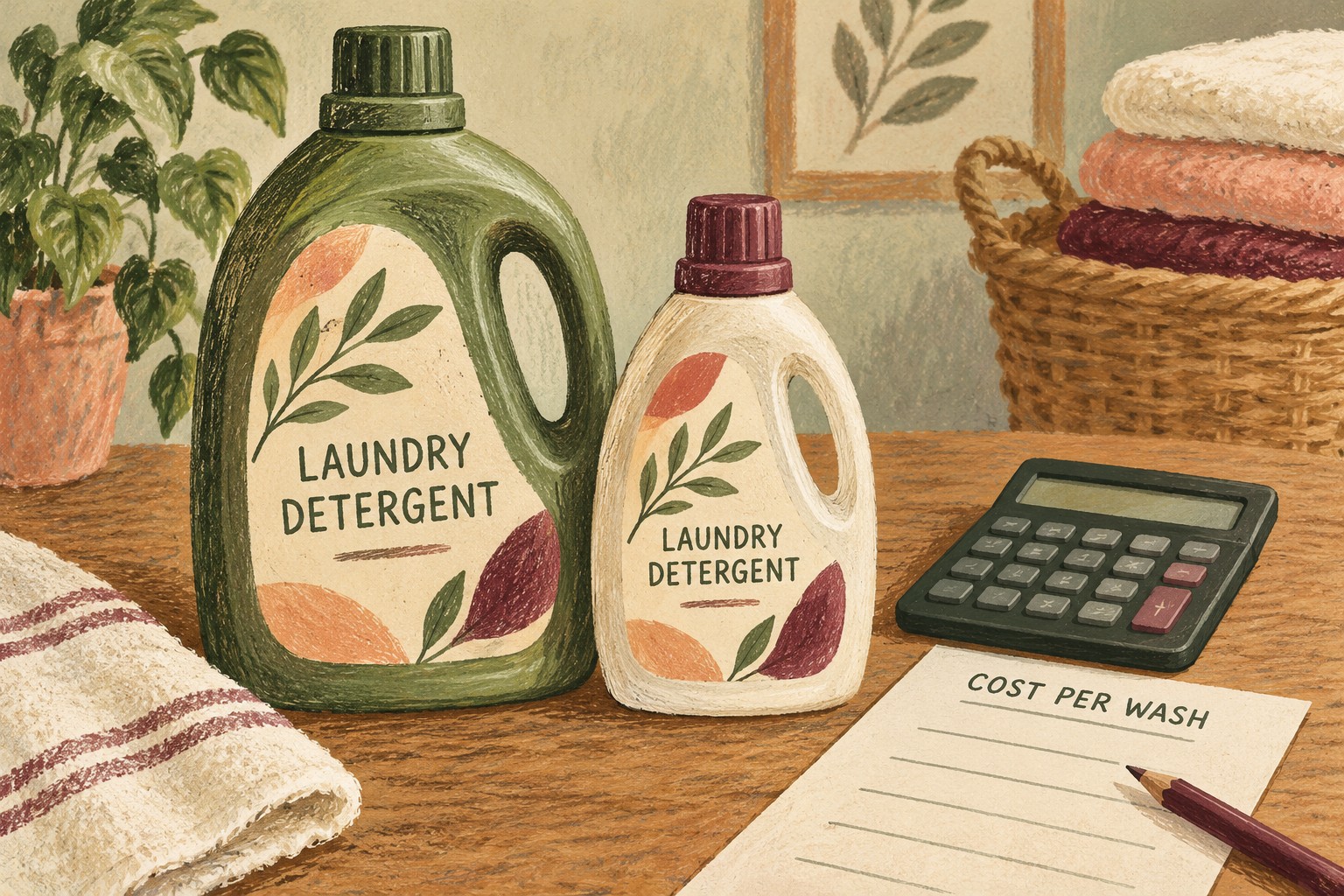
Suppose product A costs £8 for 1,000 ml and your label-directed dose is 25 ml. That gives 40 washes, so the detergent cost is 20 pence per wash. Product B costs £10 for 1,500 ml but requires 50 ml in the same household conditions. That gives 30 washes, or about 33 pence per wash. The larger bottle has a lower price per litre but a higher estimated cost per wash in this example.
These figures are illustrative, not current prices or a recommendation for particular products. If the dose changes for a larger or dirtier load, recalculate. For a pod product, use the number of pods the label specifies for that load, not automatically one. A pack count is not always a wash count.
Add the costs the comparison leaves out
Include delivery or a compulsory subscription charge if it applies. Separate one-time starter-container costs from repeat refills. A bulk discount only helps if the product can be stored correctly and used within its relevant period. Do not buy an oversized supply solely because the arithmetic looks attractive.
The calculation does not prove equal performance, fragrance suitability or compatibility with every fabric. First confirm that both products can do the job and fit your household preferences. Then compare cost. A cheap dose that requires an unsuitable routine is not a useful saving.
Check the measure in ordinary use
Use the measuring device as instructed. A cap may have several marks, and filling it to the rim can differ substantially from the required dose. If household members share washing, keep the dose information visible rather than relying on a remembered splash.
After several washes, compare expected consumption with the amount remaining. Large differences may reveal dosing habits or a mistaken assumption in the calculation. Do not infer chemical safety from cost per wash; it is a budgeting measure. Keep the result alongside the use instructions so the cheaper choice remains a correctly used one.